hairstylist tax deductions: the complete write-off list
If you rent a booth or suite, or you're an independent barber, you file a Schedule C and every dollar you don't deduct is taxed at roughly 30–40% once self-employment tax is added. Here is everything you can write off, where it goes on the form, and the handful of things people get wrong.
are you actually self-employed?
This guide is for hair professionals who are self-employed — roughly half of hairstylists and three-quarters of barbers, per the Bureau of Labor Statistics — : booth renters, salon-suite owners, mobile stylists, and independent barbers with no employees. If you get a W-2 from a salon, you're an employee and can't deduct work expenses on your federal return (a handful of states still allow it). If you own a salon with staff on payroll, most of this still applies but you have payroll, rent, and inventory questions this page doesn't cover.
Quick test: did a client's card payment land in your Square, Stripe, GlossGenius, Vagaro, or Booksy account? Then it's your income, you owe self-employment tax on the profit, and every deduction below lowers that bill.
what can a hairstylist or barber write off?
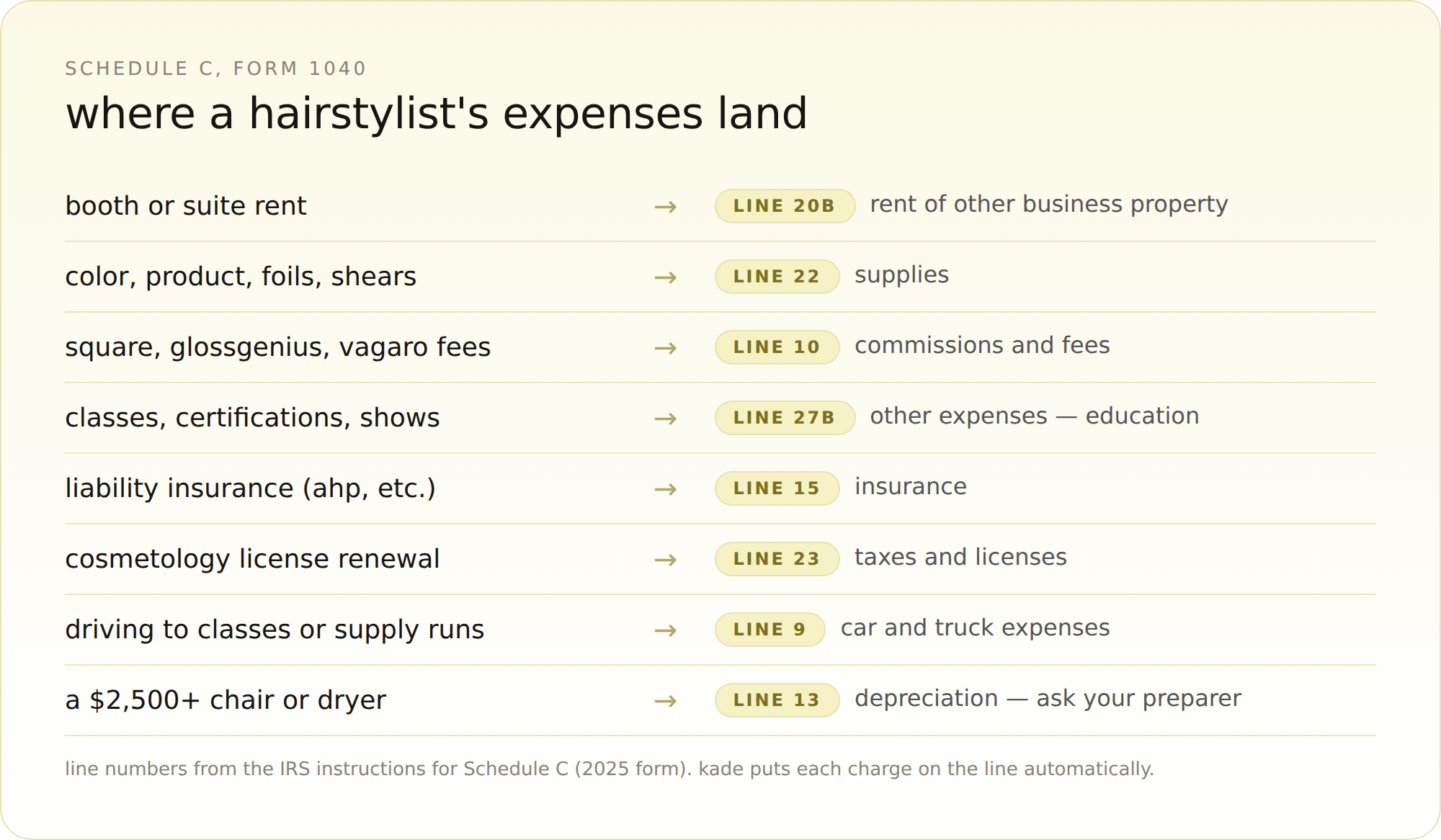
The line numbers below come from the IRS instructions for Schedule C — the document your preparer works from, and the one to check if a line ever moves.
Ordered roughly by how much they're worth to a typical solo stylist. The pill on the right is the Schedule C line your preparer will put it on.
Booth rent, suite rent, chair rent
Weekly or monthly rent paid to a salon, Sola/Phenix-style suite, or barbershop for your space. This is usually the single biggest deduction a booth renter has, and it comes straight off your bank statement.
Color, product, and back-bar supplies
Everything you use on clients: color, developer, lightener, shampoo, styling product, foils, gloves, capes, towels, blades, neck strips. SalonCentric, CosmoProf, State Beauty, Sally, Amazon orders for the chair. Retail inventory you resell is handled differently (see the CPA note below).
Shears, clippers, dryers, irons, chairs
Tools under $2,500 apiece can generally be written off in the year you buy them. A single purchase of $2,500 or more (a new chair, a shampoo station, a high-end clipper set) may need to be depreciated instead — that's a CPA call, and kade flags those for you.
Card processing and booking-app fees
The fees Square, Stripe, GlossGenius, Vagaro, Booksy, Fresha, and StyleSeat take out of every payout. Small per transaction, but they add up to several hundred dollars a year for most stylists and most people never claim them.
Booking software and subscriptions
Your booking app's monthly plan, plus Canva, Squarespace, Adobe, Mailchimp, Spotify for the shop, music licensing, Dropbox — anything you pay for monthly to run the business.
Continuing education
Classes, certifications, masterclasses, hair shows, and industry summits that maintain or improve your skills. State-required CE hours count. Education to enter a new trade doesn't.
License and permit fees
Cosmetology or barber license renewal, booth-rental permits, business registration, local business tax. Sales tax you collect and remit is not an expense — it was never your income.
Liability insurance
Professional liability policies (AHP, Next, Hiscox, Beauty Insurance Plus) and any general liability your suite lease requires. Health insurance premiums are deductible too but go on your 1040, not Schedule C.
Advertising and marketing
Instagram and Facebook boosts, business cards, website hosting, photo shoots for your portfolio, model fees, signage, referral gifts to clients.
Business phone and internet
The business-use share of your cell phone and, if you run a suite, the internet you pay for there. Most solo stylists claim 50–80% of the phone bill; keep the percentage reasonable and consistent.
Mileage and travel
Driving between locations, to the supply store, to a class, or to an on-site bridal job — not your commute from home to your regular chair. Travel to out-of-town education or shows: airfare, hotel, and 50% of meals (the limit comes from IRS Publication 463).
Professional services
Your CPA or tax preparer, bookkeeping software like kade, a lawyer who reviewed your lease, a business coach.
Assistants and contract help
Anyone you paid to help — a shampoo assistant, a photographer, a cleaner for your suite — who isn't your employee. If you paid an individual $600 or more in a year you generally owe them a 1099-NEC.
Bank fees and business account charges
Monthly maintenance fees, wire fees, and overdraft fees on the account you run the business from.
which deductions do stylists miss most?
Working through real stylist statements, the same five deductions get skipped year after year:
- Processing fees. They come out before the money hits your account, so they never look like a purchase. A stylist doing $60,000 in card sales pays roughly $1,600–2,000 in fees. Claim them.
- The booking app itself. $30–$60 a month, every month, buried in the subscription noise.
- Mileage to the supply store and to classes. Not the commute — the other driving. It adds up fast at the IRS standard mileage rate.
- Liability insurance. Often paid once a year, so it isn't on most months' statements and gets forgotten.
- The 50% of meals at a hair show or during out-of-town education.
what looks deductible but works differently?
Retail inventory
Product you buy to resell (not to use on clients) is inventory, not supplies. It's deducted as you sell it, through Part III of Schedule C. Kade flags large supply purchases so you and your CPA can decide.
Home office
If you do your books, ordering, and client messaging from a dedicated space at home, you may qualify. The rules are strict (regular and exclusive use) and the math is separate from your statement, so kade leaves this to your CPA.
Self-employment tax and the QBI deduction
Half of your self-employment tax and the 20% qualified business income deduction are real money, but they're calculated on your 1040 from your Schedule C profit, not deducted on Schedule C itself.
Clothing and personal grooming
Black work clothes, your own haircuts, nails, and gym memberships are personal, even if clients see you. Only true uniforms or protective gear (aprons, gloves) qualify.
how do you keep track without a spreadsheet?
You don't need a receipt app or a spreadsheet. Almost every deduction above is already sitting in your bank and card statements: the rent payment to the suite, the SalonCentric charge, the Booksy subscription, the fee Square took out of Friday's payout. The work is sorting those lines into the right Schedule C categories, and doing it for twelve months without falling behind.
That's what kade does. Upload a statement (PDF or CSV), and it categorizes each transaction onto the right line, flags anything ambiguous for a one-tap answer, catches the $2,500 purchases, and gives you a year-end package your CPA can file from. Your first statement is free.
see what your statement is already telling you.
upload one bank or card statement and get it sorted onto schedule c in about ten minutes. no app to set up, no receipts to log.
start freeThis guide is general information about federal taxes for self-employed hair professionals and is not tax advice. Rules change and your situation is specific to you; confirm anything you rely on with a tax professional.