massage therapist tax deductions: the complete write-off list
Written by a bookkeeper and QuickBooks Certified ProAdvisor. This is the list we actually use with self-employed massage therapists and bodyworkers — and the write-offs that get disallowed. Updated for the 2026 Schedule C.
First: are you actually self-employed?
This question matters more in massage than in almost any other trade, because misclassification is everywhere. Plenty of therapists are handed a 1099 by a spa when the IRS would call them an employee. So start here.
You're self-employed (and everything below applies) if you rent a room, suite, or table space; set your own hours and rates; bring or keep your own clients; carry your own liability insurance; and supply your own table, linens, and oils. You file a Schedule C with your 1040.
You're an employee if the spa sets your schedule, sets your prices, assigns you clients, requires their protocols and paperwork, and provides the room, table, and supplies. Employees get a W-2 — and since 2018, W-2 employees generally can't deduct unreimbursed work expenses on their federal return. If your employer doesn't reimburse your CE or your table, that money is simply gone federally. (Some states still allow a portion on the state return.)
And then there's the messy middle. A lot of therapists get a 1099 while being treated exactly like an employee: the spa's room, the spa's table, the spa's booking system, the spa's clients, the spa's protocols, a schedule they don't control. Calling someone a contractor in a contract doesn't make them one — the IRS looks at who actually controls the work — its own employee-or-contractor test turns on behavioral control, financial control, and the relationship. This gets litigated constantly in spa and wellness settings.
Why it matters to you in dollars: as a 1099 worker you pay both halves of Social Security and Medicare — about 15.3% on top of income tax — that an employer would otherwise split with you. If you think you've been misclassified, Form SS-8 asks the IRS to make a determination, and Form 8919 lets you pay only the employee half of those taxes while it's sorted out. This is worth a conversation with a tax professional rather than a decision you make alone.
The rest of this guide is for therapists who are genuinely self-employed — which, per the Bureau of Labor Statistics, is a large share of the field, since so many work from rented rooms or a home studio.
The deductions almost every therapist has
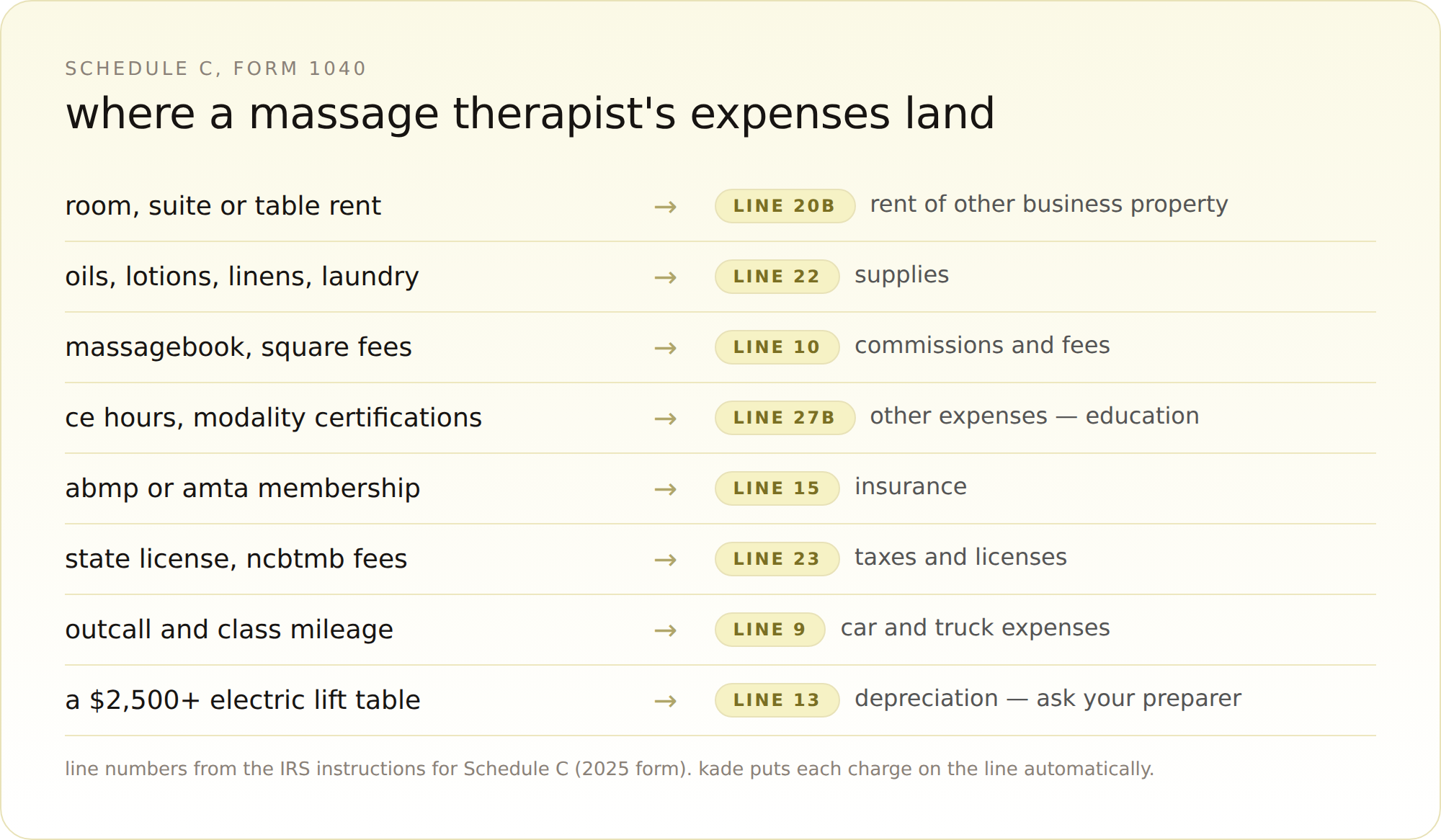
Each one lists the Schedule C line it belongs on, so nothing has to be guessed at in April. The lines come from the IRS instructions for Schedule C, which is what your preparer works from.
Room, suite, or table rent line 20b
Usually the biggest one, and fully deductible. Whether you rent a room in a wellness center, a suite in a Sola or Phenix, space in a chiropractor's or salon's office, or pay a flat monthly fee for a table spot — it's rent, and it goes on Line 20b, "rent or lease — other business property." If your rent bundles utilities, laundry, or a front desk, the whole payment is still rent.
Oils, lotions, creams, and treatment supplies line 22
Everything you use up on clients: massage oil, lotion, cream, gel, arnica, essential oils, hot stones, cupping sets, kinesiology tape, table warmer covers, disposable face cradle covers, gloves, sanitizer. Biotone, Bon Vital, Soothing Touch, Sacred Earth, Massage Warehouse, Pure Spa Direct — all Line 22, supplies.
Linens — and laundry line 22
The expense nobody thinks to claim. Sheets, bolster covers, face cradle covers, towels, and blankets are supplies. So is the cost of keeping them clean: a linen service, laundromat runs, or detergent bought specifically for business linens. If you wash client linens at home, you can't deduct your household utilities for it, but the service, the laundromat, and the supplies are fair game. A therapist doing 20 sessions a week is laundering constantly, and over a year it's real money.
Your table and equipment line 22 · or line 13 if it's big
Bolsters, wedges, stools, table warmers, hot stone heaters, and small tools are just supplies (Line 22). A table is the judgment call: a $300 portable is routinely expensed, while a $2,500 electric lift table is an asset, and whether it's deducted this year or depreciated over several is a Line 13 decision your tax preparer makes. Your job is just to make sure the purchase is recorded and easy to find. Rule of thumb: under $2,500 per item is routinely expensed; at $2,500 and above, flag it for your preparer.
License and permits line 23
Your state massage license renewal, any city or county business license, and NCBTMB certification fees. Line 23, taxes and licenses. Small, annual, and easy to forget.
Liability insurance and professional membership line 15
ABMP, AMTA, or a standalone professional liability policy — Line 15. Worth knowing: for ABMP and AMTA the membership is the insurance, so the whole dues payment belongs here rather than being split out. Not your health insurance — that's deductible too, but elsewhere (see below).
Continuing education line 27b
Most states require CE hours to renew your license, which makes this one of the most reliable deductions in the trade — and one of the most commonly missed, because classes get paid for on a personal card. NCBTMB-approved courses, hands-on workshops, online CE, modality certifications (myofascial, lymphatic, prenatal, cupping), and the conference registration itself: all Line 27b. Education that maintains or improves the skills you already use is deductible; education to enter a new profession is not.
Booking software and processing fees line 27b · line 10
Two different lines. The subscription for MassageBook, Jane, Mindbody, Noterro, Vagaro, Square Appointments, or your website — Line 27b. The processing fees those platforms and Square take out of each payment — Line 10, commissions and fees. That second one is bigger than most therapists realize: at roughly 2.5–3.5% of everything you collect, a $60,000 year quietly pays out $1,500–2,100 in fees, and it's fully deductible.
Music, ambiance, and the little things line 27b
A business streaming subscription for treatment-room music, candles, diffusers and diffuser oils, a sound machine. Small individually; they add up across a year.
Phone and internet line 25
Deduct the business-use portion. If you book clients, run your business, and take payments from your phone, a defensible business percentage (many solo therapists land between 50% and 80%) is reasonable. Pick a number you can explain and stay consistent. 100% invites questions unless it's a dedicated business line.
Mileage line 9
The rule that trips everyone: driving from home to the room you rent every day is commuting, and commuting is never deductible.
What is deductible: driving to a client for outcall or mobile work, to a CE class or conference, to pick up supplies, to a chair-massage gig at an office or event, between two locations if you work at more than one, and to the bank for the business. For 2026 the IRS rate is 72.5¢ per mile January through June and 76¢ from July 1 on — so a 2026 log needs dates, not just a total. Keep it simple: date, destination, purpose, miles. Without a log, mileage is the first thing to be disallowed. For mobile therapists this is often one of the largest deductions of the year.
The ones some therapists have
Home studio line 30
If you treat clients in a dedicated room at home, you may qualify for the home office deduction — but the space must be used regularly and exclusively for the business. A room with your table in it that's also the guest room doesn't qualify. If you do qualify, the simplified method in IRS Publication 587 is $5 per square foot up to 300 square feet, with no utility receipts required.
Mobile and outcall work
If you travel to clients, your mileage (above) is the main deduction, plus the gear that makes it possible: a portable table, a carry case, a cart. Track mileage carefully — for a mobile practice it's usually the single biggest line.
Retail products you sell line 4 · cost of goods sold
Selling lotions, CBD balms, or self-care tools to clients? What you paid for that inventory is cost of goods sold, not supplies — a separate calculation (Part III of Schedule C) that accounts for what's still on the shelf at year-end. Small retail is manageable; real inventory is worth getting help with.
Contract help line 11
Paid a front-desk person, a cleaner, or another therapist to cover you as an independent contractor? Line 11. If you paid any one person $2,000 or more in 2026, you're expected to issue a 1099-NEC. (That threshold was $600 through 2025 and rose to $2,000 starting with 2026 payments.)
Business meals line 24b
50% deductible (per IRS Publication 463) when there's a genuine business purpose — lunch with a chiropractor who refers to you, coffee with a therapist you're subletting to. Your own lunch between clients is not a business meal, however long the day was.
Health insurance premiums
If you're self-employed and buy your own health coverage, the premiums are deductible — but on Schedule 1 of your 1040, not on Schedule C. It's a big number, and it's frequently either missed or put in the wrong place.
The ones people get wrong
Every one of these gets claimed, and every one gets disallowed.
Your own massages and bodywork. "It's research" and "I need to stay in shape for this work" don't hold. Your own treatments are personal care. The narrow exception is a genuine trade of services, which isn't a deduction at all — it's barter, and both sides are supposed to report the value as income.
The gym, supplements, and chiropractic care for yourself. Physically demanding work doesn't make personal health spending deductible. It may be a medical expense on Schedule A, but it isn't a business expense.
Clothes. Scrubs and comfortable pants aren't deductible if they're suitable for everyday wear. A branded polo or a logo'd uniform is; your wardrobe isn't.
Commuting miles. Home to your regular room and back. The single most common error.
100% of your phone. Claim a percentage unless it's a dedicated business line.
Personal purchases on the business card. Mixing doesn't make the personal part deductible — it just makes your books harder to sort.
Unreported cash and tips. Not a deduction issue, an income one — but it's where therapists get into real trouble. Tips are taxable income, including cash.
The income side — tips and gift certificates
Deductions only matter against income, so a word on what counts. All of it counts: card payments through your booking app, Venmo and Zelle from clients, checks, and cash — including cash tips, which are a larger share of income in massage than in most trades. Your 1099-K from Square or MassageBook won't include cash, so you add that yourself.
Gift certificates catch people out. Most therapists are cash-basis filers, which means the money is income when you receive it — not when the session is finally redeemed months later. Sell a lot of certificates in December and that's December income, even if the massage happens in March. Plan for it rather than being surprised by it.
Two things that are not income: money you move between your own accounts, and money you put into the business from savings. Those are transfers, and counting them as income overstates what you owe.
How to actually keep track
The therapists who have an easy April aren't the organized ones. They're the ones with the simplest system. Three habits:
- Run business money through one account. Not perfectly — just mostly. When most business spending goes through one card, your bank statement is your bookkeeping, and the auto-drafts you'd never remember to log (insurance, ABMP dues, your booking subscription) are captured automatically.
- Keep a mileage log. A notes app is fine. Date, destination, purpose, miles. No log, no deduction — and in 2026, record dates, because the rate changed mid-year.
- Sort transactions monthly, not yearly. Twelve small sessions beat one miserable one, and you'll remember what that $84 charge was in month one, not month thirteen.
Keep receipts for anything over about $75 and for all equipment. For everyday supplies, your card statement is generally acceptable documentation.
Quick answers
Do I need to pay quarterly taxes?
Probably. If you'll owe $1,000 or more for the year, the IRS expects estimated payments in April, June, September, and January. Nobody is withholding for you. Skipping them doesn't change what you owe — it adds a penalty.
What is self-employment tax?
Social Security and Medicare that an employer would normally split with you. Self-employed, you pay both halves — about 15.3% of your net profit — on top of income tax. It's what surprises first-year renters most. Half of it is deductible on Schedule 1.
Can I deduct my massage table if I bought it before I went independent?
If you convert personal equipment to business use, there are rules for the value you can claim, and it's usually the lower of cost or current fair market value. Worth asking your preparer rather than guessing.
My spa gave me a 1099 but treats me like an employee. What do I do?
You still have to report the income. But if you believe you've been misclassified, Form SS-8 asks the IRS to determine your status, and Form 8919 lets you pay only the employee share of Social Security and Medicare. Talk to a tax professional before filing either — it's a real conversation with your workplace attached to it.
What if I have no receipts for last year?
Start with your bank and card statements — they document nearly everything. Reconstruct mileage from your calendar and appointment history. Be honest about what you can't support. Then set up the one-account habit so it never happens again.
- IRS — Instructions for Schedule C (Form 1040)
- IRS — Independent contractor (self-employed) or employee?
- IRS — About Form SS-8
- IRS — About Form 8919
- IRS — Standard mileage rates
- IRS — Publication 463, Travel, Gift, and Car Expenses
- IRS — Publication 587, Business Use of Your Home
- IRS — Estimated taxes
- U.S. Bureau of Labor Statistics — Massage Therapists
Doing this by hand is the miserable part. kade was built for exactly this: upload your bank or card statement and it sorts every transaction onto the right Schedule C line — room rent to 20b, Massage Warehouse to 22, MassageBook fees to 10, ABMP to 15 — and flags the handful that need a quick yes or no. Nothing to log. Your first statement is free.
see how kade worksThis guide is general information for self-employed massage therapists and bodyworkers filing Schedule C in the United States. It isn't tax advice for your situation, and rules change — confirm current figures and check with a qualified tax professional for anything you're unsure about.